 TIGERFASTENERS
Threaded rod: DIN 975 is withdrawn, and an unpainted end usually means 4.8
Threaded rod is still sold as “DIN 975”. That standard is withdrawn; its replacement is DIN 976-1. A rod is thread from end to end and shows nothing of its strength, so the standard marks the end face with the property class or a colour: 8.8 yellow, 10.9 white, 12.9 black. Class 4.8 needs no marking at all. A rod with a clean end face is therefore most likely 4.8. In M10, 4.8 has a minimum breaking load of 24.4 kN and 8.8 has 46.4 kN. About 6 minutes to read.
DIN 975 became DIN 976-1
A 2018 practice note from Steel Construction New Zealand, MAT1011, opens with it: threaded bar used to be supplied to DIN 975, which is withdrawn, and the replacement is DIN 976-1, revised in 2016. The delivery conditions below are taken from the table in that note; this site has not read DIN 976-1 itself.
| Item | Requirement |
|---|---|
| Thread tolerance | 6g (ISO 965-2) |
| Mechanical properties | M3–M39: 4.8, 5.6, 5.8, 8.8, 10.9, 12.9 to ISO 898-1:2013 |
| Tolerances | Product grade A (ISO 4759-1) |
| Surface finish | Electroplating ISO 4042, zinc flake ISO 10683, hot-dip galvanizing ISO 10684 |
The classes are those of ISO 898-1, the bolt numbers. A rod has no head, so the class can only go on the end.
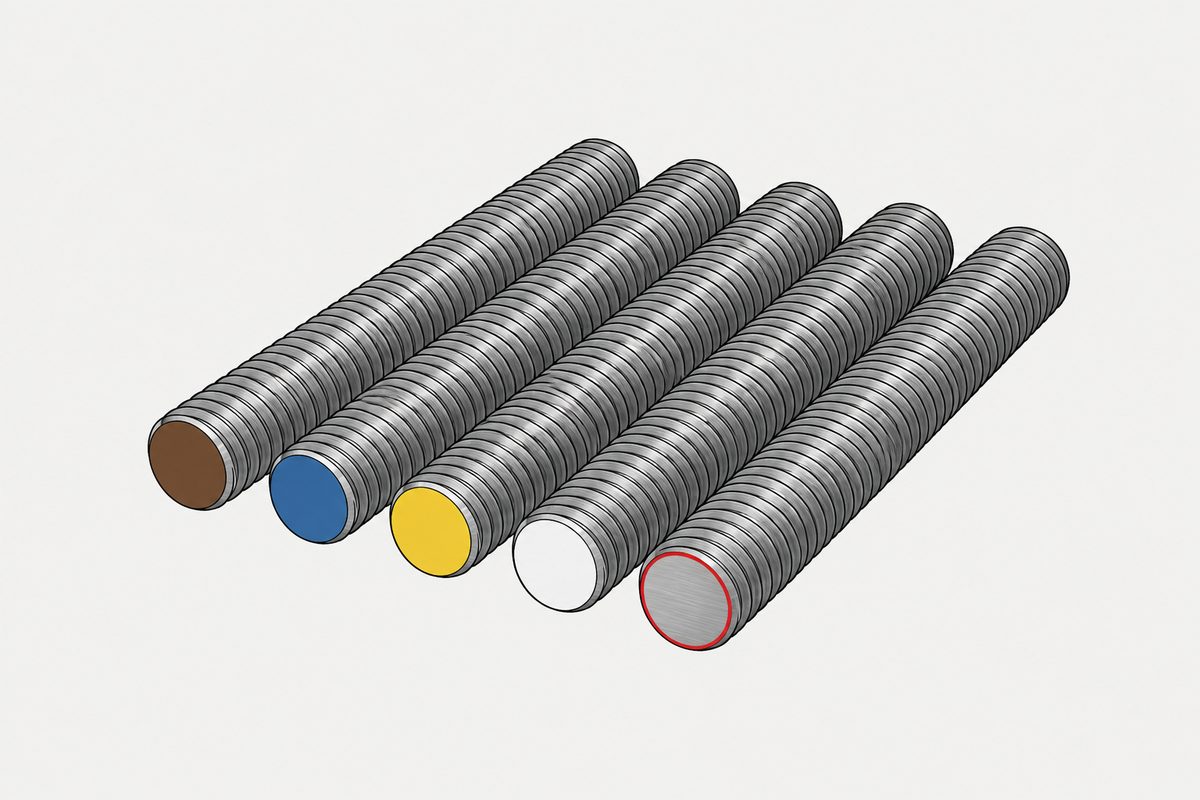
The colour on the end is the property class
As SCNZ sets it out, rods above M5 are marked at one end with the property class, except class 4.8. The dot may be omitted, so 88 is acceptable for 8.8, and ISO 898-1 clock marking may be used instead. Colour coding is also acceptable:
| Property class | Colour |
|---|---|
| 4.6, 4.8 | Not required |
| 5.6 | Brown, RAL 8015 |
| 5.8 | Blue, RAL 5010 |
| 8.8 | Yellow, RAL 1023 |
| 10.9 | White, RAL 1013 |
| 12.9 | Black, RAL 9017 |
The table covers carbon and alloy steel only. Stainless rod is not in it; the German parts supplier Mädler describes its A2 (V2A) stainless rod as “marked with green paint”, which is the supplier’s own marking rather than a row of this table. If an end face is green, ask what it means.
How far apart 4.8 and 8.8 are
Minimum tensile strength from ISO 898-1 times the stress area gives the rod’s minimum breaking load. The M10 stress area is 58.0 mm², the same figure used by this site’s fastener calculators.
| Class | Min. tensile strength | Min. breaking load | Proof stress | Proof load |
|---|---|---|---|---|
| 4.8 | 420 MPa | 24.4 kN | 310 MPa | 18.0 kN |
| 8.8 | 800 MPa | 46.4 kN | 580 MPa | 33.6 kN |
Nearly a factor of two, and they look the same. An M8 rod in 4.8 is 420 × 36.6 = 15.4 kN. These are material minimums, not working loads; this page does not apply design factors.
Hung from a ceiling, the rod is usually not the weak link. In How much can a wedge anchor hold, one M10 anchor in C20/25 concrete has a permissible tension of 4.1 to 9.5 kN, all below the 18.0 kN proof load of a 4.8 rod. The anchor and the concrete decide what can hang.
Can 8.8 rod be hot-dip galvanized?
SCNZ’s reasoning: 8.8 rod to DIN 976-1 is thread rolled and then heat treated, which removes the work hardening from rolling and leaves a fairly uniform 23 to 34 HRC per ISO 898-1, below the 37 HRC they cite for hydrogen embrittlement concern, so it can be hot-dip galvanized without further stress relief. The conclusion rests on that process order; a different maker or route needs checking (The rust-proofing that breaks the screw: hydrogen embrittlement).
Inch rod is outside this standard
DIN 976-1 Part 1 is metric thread. Its classes, colours and delivery conditions do not apply to inch rod such as 3/8″. For inch rod, ask which inch standard and which material grade it is made to.
What to put on an order
Following the packaging marks SCNZ lists, a full description is: product (threaded bar), M for ISO metric coarse thread, nominal diameter, nominal length, property class and coating. The class is the field most often left out, and without it the rod that arrives is usually the one with a bare end.
What this page cannot conclude
DIN 976-1 itself was not read; delivery conditions, marking and colours come from SCNZ MAT1011. Breaking and proof loads are material minimums, not design values, and no steel design code was read. This page gives no answer for stainless or inch rod marking.
This page covers step 2, the thread. The whole order is substrate, thread, head, drive, finish, documentation, and why doing it out of order is rework rather than a tweak is in specifying a screw.
Common questions
Is threaded rod DIN 975 or DIN 976?
DIN 975 is withdrawn and replaced by DIN 976-1, revised in 2016. As tabulated by Steel Construction New Zealand in MAT1011, its delivery conditions are 6g thread tolerance, mechanical properties to ISO 898-1:2013, product grade A, and classes 4.8, 5.6, 5.8, 8.8, 10.9 and 12.9 from M3 to M39.
What does the colour on a threaded rod end mean?
The property class. In the colour coding SCNZ gives, 5.6 is brown, 5.8 blue, 8.8 yellow, 10.9 white and 12.9 black; 4.6 and 4.8 need no marking. A rod with an unmarked end is most likely 4.8. Stainless rod is not in the table; at least one supplier marks A2 rod green as its own convention.
How much load can an M10 threaded rod take?
ISO 898-1 minimum tensile strength times the 58.0 mm² stress area: class 4.8 has a minimum breaking load of 24.4 kN and proof load of 18.0 kN; class 8.8 has 46.4 kN and 33.6 kN. These are material minimums, not working loads.
References
- SCNZ Steel Advisor MAT1011 (2018-02-20) — Practice Note on the Sourcing of Threaded Rod Used for Foundation Bolts. Table 1, Table 2, Traceability
- Mädler — Threaded bar DIN 976-1 A (ex DIN 975) stainless steel V2A, marked with colour green
- Fastener calculators — stress area and ISO 898-1 values
- How much can a wedge anchor hold — the anchor and the concrete usually govern a hanging load
- Galvanized high-strength bolts — torque coefficient and turn-of-nut
DIN 976-1 was not read; delivery conditions, marking and colours are as tabulated in SCNZ MAT1011. ISO 898-1 values and stress areas are those already verified for this site’s calculator page; breaking and proof loads are this site’s arithmetic of 2026-10-02. Mädler’s green marking is a supplier product description, not a standard requirement.
Enquiries
For threaded rod, give metric or inch, diameter, length, property class and coating, and say if you need end-face colour or class marking.
Request a quotation
Tell us the part and the quantity. We will come back on feasibility, lead time and price.
Or email us directly sales@tigerfasteners.com