 TIGERFASTENERS
Wood Screws
Wood screws have coarse, deep threads and usually an unthreaded shank. The shank exists so the top piece can be pulled tight — if the thread ran to the head, both pieces would be held apart by their own threads and never close.
Specification options
| Volume range | M1.0 – M5.0 |
|---|---|
| Maximum size | M16 |
| Standards | DIN 96 · DIN 97 · DIN 571 · ISO 1482 · ISO 1483 · JIS B 1112 |
| Materials | see Materials |
| Finishes | see Finishes |
| Minimum order | From 10,000 pcs, depending on the part |
Head styles
%20Countersunk%20/%20Flat%20Head'%3e%3ctitle%3e皿頭(平頭)%20Countersunk%20/%20Flat%20Head%3c/title%3e%3cg%20fill='none'%20stroke='%2316181A'%20stroke-width='2.4'%20stroke-linejoin='miter'%20stroke-linecap='butt'%3e%3cpath%20d='M%2030%2026%20L%2090%2026%20L%2071%2046%20L%2049%2046%20Z'%20/%3e%3cpath%20d='M%2049%2046%20L%2052%2049.5%20L%2049%2053%20L%2052%2056.5%20L%2049%2060%20L%2052%2063.5%20L%2049%2067%20L%2052%2070.5%20L%2049%2074%20L%2052%2077.5%20L%2049%2081%20L%2052%2084.5%20L%2049%2088%20L%2052%2091.5%20L%2049%2095%20L%2052%2098.5%20L%2049%20102%20L%2052%20105.5%20L%2049%20109%20L%2052%20112.5%20L%2049%20116%20L%2052%20119.5%20L%2049%20123'%20/%3e%3cpath%20d='M%2071%2046%20L%2068%2049.5%20L%2071%2053%20L%2068%2056.5%20L%2071%2060%20L%2068%2063.5%20L%2071%2067%20L%2068%2070.5%20L%2071%2074%20L%2068%2077.5%20L%2071%2081%20L%2068%2084.5%20L%2071%2088%20L%2068%2091.5%20L%2071%2095%20L%2068%2098.5%20L%2071%20102%20L%2068%20105.5%20L%2071%20109%20L%2068%20112.5%20L%2071%20116%20L%2068%20119.5%20L%2071%20123'%20/%3e%3cpath%20d='M%2049%20123%20L%2071%20123'%20/%3e%3c/g%3e%3c/svg%3e)
%20Oval%20/%20Raised%20Countersunk'%3e%3ctitle%3e半皿頭(橢圓頭)%20Oval%20/%20Raised%20Countersunk%3c/title%3e%3cg%20fill='none'%20stroke='%2316181A'%20stroke-width='2.4'%20stroke-linejoin='miter'%20stroke-linecap='butt'%3e%3cpath%20d='M%2030%2026%20Q%2060%2012%2090%2026%20L%2071%2046%20L%2049%2046%20Z'%20/%3e%3cpath%20d='M%2049%2046%20L%2052%2049.5%20L%2049%2053%20L%2052%2056.5%20L%2049%2060%20L%2052%2063.5%20L%2049%2067%20L%2052%2070.5%20L%2049%2074%20L%2052%2077.5%20L%2049%2081%20L%2052%2084.5%20L%2049%2088%20L%2052%2091.5%20L%2049%2095%20L%2052%2098.5%20L%2049%20102%20L%2052%20105.5%20L%2049%20109%20L%2052%20112.5%20L%2049%20116%20L%2052%20119.5%20L%2049%20123'%20/%3e%3cpath%20d='M%2071%2046%20L%2068%2049.5%20L%2071%2053%20L%2068%2056.5%20L%2071%2060%20L%2068%2063.5%20L%2071%2067%20L%2068%2070.5%20L%2071%2074%20L%2068%2077.5%20L%2071%2081%20L%2068%2084.5%20L%2071%2088%20L%2068%2091.5%20L%2071%2095%20L%2068%2098.5%20L%2071%20102%20L%2068%20105.5%20L%2071%20109%20L%2068%20112.5%20L%2071%20116%20L%2068%20119.5%20L%2071%20123'%20/%3e%3cpath%20d='M%2049%20123%20L%2071%20123'%20/%3e%3c/g%3e%3c/svg%3e)

Drive types


Choosing the thread
-
Fully threaded
Maximum grip; for single-layer or end fixing.
-
Partially threadedwith shank
For drawing two pieces together. The shank passes through the upper piece without engaging, so the head can pull it down.
Where it most often goes wrong
Each of these causes scrapped lots or rework on the floor. None of them is theoretical.
No pilot hole in hardwood. Driving straight in splits the timber, especially near ends and edges. Pilot in two diameters: shank diameter for the plain section, root diameter for the threaded one.
The pilot rule is multiplied by the wrong diameter. The Wood Handbook states the pilot hole as a percentage of the root diameter — and a few pages later, in the same chapter, its screw-number table lists the shank diameter:
| No. | mm | in |
|---|---|---|
| 4 | 2,84 mm | 0.112 in |
| 6 | 3,51 mm | 0.138 in |
| 8 | 4,17 mm | 0.164 in |
| 10 | 4,83 mm | 0.190 in |
| 11 | 5,16 mm | 0.203 in |
| 12 | 5,49 mm | 0.216 in |
| 14 | 6,15 mm | 0.242 in |
| 16 | 6,81 mm | 0.268 in |
Countersunk head without a countersink. The cone pulls itself flush; in hardwood without a prepared countersink it splits the surrounding fibre instead.
Zinc plating outdoors. It does not last, and ACQ-treated timber contains copper, which accelerates corrosion of a zinc coating. Outdoor timber needs hot-dip galvanised, stainless or a proprietary coating.
How length is measured
One rule covers it: if the head sinks into the work, measure overall; if it stays on the surface, measure under the head.
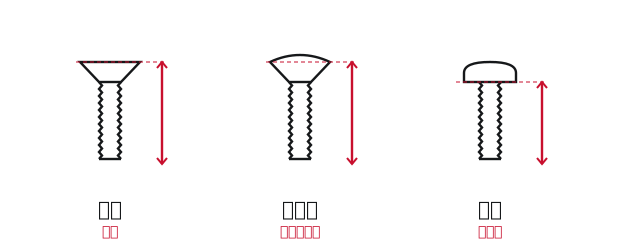
| Head style | Datum | Why |
|---|---|---|
| Countersunk (flat) | Overall length | The head sits flush in the countersink, so it counts |
| Oval (raised countersunk) | Overall to the head diameter | The cone sinks, the dome stays proud; measure to where they meet |
| Pan / round | Under head | The head stays entirely on the surface |
| Button | Under head | Same |
| Hex / hex washer | Under head | Same |
| Socket head cap | Under head | Same |
Full explanation → Where the standards stop at this size → Tolerance stack-up and the screw →
Enquiries
Wood Screws come in a lot of combinations. Tell us the item, size, material, finish, annual usage and application, and we will come back on feasibility and lead time. A drawing or a sample is fastest — quoting against the real part saves a great deal of guessing.
Volume range M1.0 – M5.0, standard fasteners up to M16. Minimum order From 10,000 pcs, depending on the part.
Request a quotation
Tell us the part and the quantity. We will come back on feasibility, lead time and price.
Or email us directly sales@tigerfasteners.com