 TIGERFASTENERS
Clear, yellow or black zinc: the colour is the passivation, and the ranking is from the hexavalent era
Clear, blue, yellow and black zinc all sit on the same electroplated zinc. The colour comes from a thin passivation film formed on top of it. A ranking still circulates in Chinese and English: yellow beats clear, olive beats black. Traced back, its stated reasons are that the coloured film was thicker and that the hexavalent chromium in it repaired scratches. Most zinc plating has since moved to trivalent chemistry, and ISO 19598 says those passivations may be dyed and tinted. The colours are still there. What they tell you has changed. About 7 minutes to read.
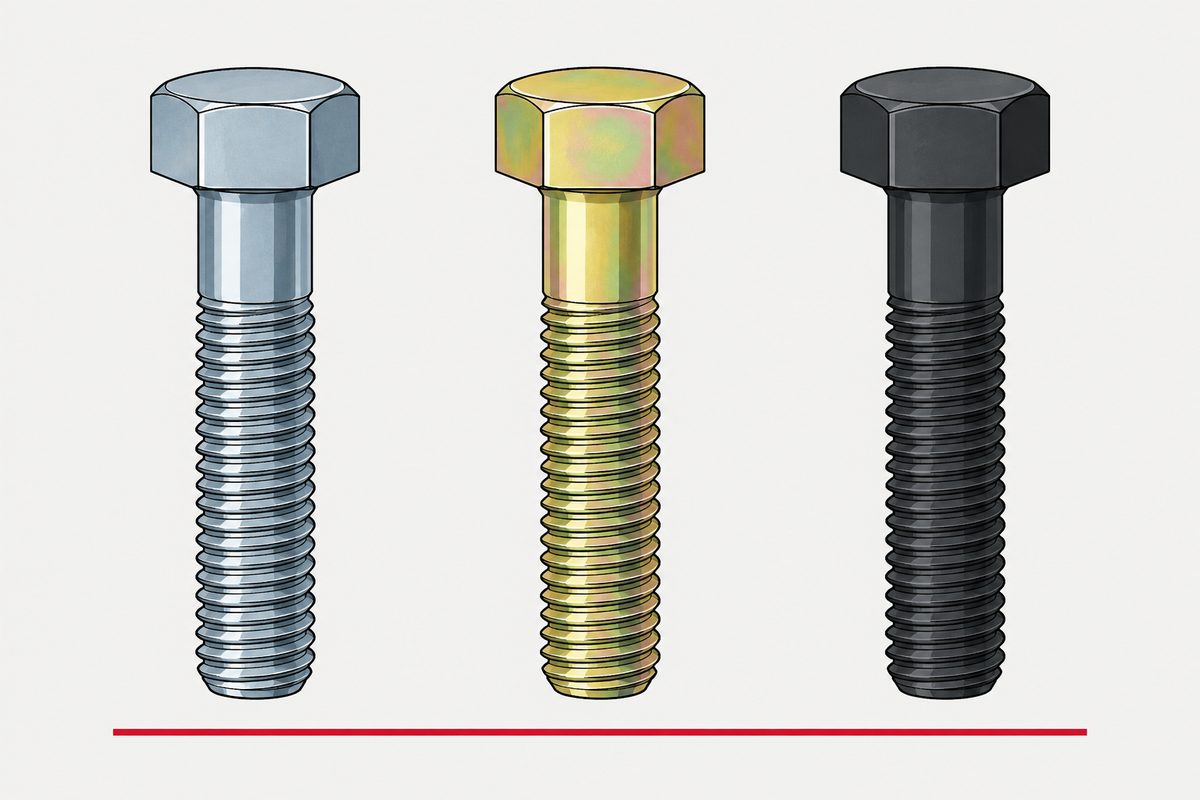
Four trade names, one zinc layer
Zinc electroplating is two steps: deposit zinc on the steel part, then dip the part in a passivation solution that converts the outermost zinc into a thin film. The standard calls that film a conversion coating. Clear, blue, yellow and black differ only in the second step; the zinc from the first step is the same.
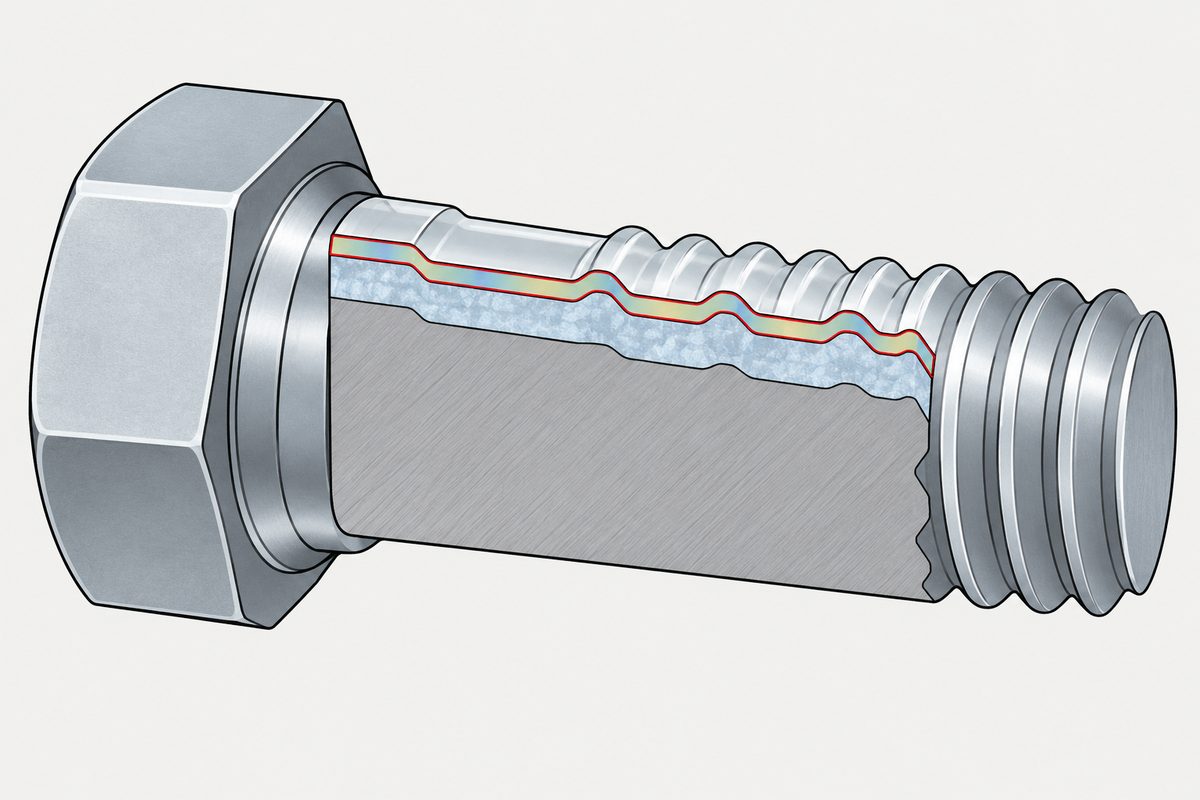
The international standard for zinc with Cr(VI)-free passivation is ISO 19598. Its Table 2 defines three types. The left column below is trade usage; the other columns use the standard’s words. Matching trade names to types is this site’s reading; the standard does not list trade names.
| Trade name | ISO 19598 type | Code | Appearance as written |
|---|---|---|---|
| Clear zinc, blue zinc | Transparent | An | Colourless to coloured and iridescent; “thin-layer passivation” |
| Yellow zinc, iridescent zinc | Iridescent | Cn | Coloured and iridescent; “thick-layer passivation” |
| Black zinc | Black | Fn | Black |
Table 2 carries a footnote: tints are permissible. Clause 4.2 adds, after the definition, that the conversion coating may optionally be dyed. Under the trivalent standard, then, a yellowish bolt may be the iridescent type or a dyed transparent one. Olive drab has no row in Table 2, and this page does not assign it one.
Where the ranking comes from
Search for the difference between clear and yellow zinc in Chinese and the same passage keeps turning up. The earliest copy that can be traced is a December 2017 post by the WeChat account “Mechanical Design Point”, republished on kknews, which ranks corrosion resistance as olive drab, then black, then iridescent, then blue-clear, then clear.
A few paragraphs earlier the same post gives its reasons: an iridescent film resists corrosion more than five times better than a colourless one, first because it is thicker, and second because when it is scratched, the hexavalent chromium in the film “re-passivates” the scratch and repairs it.
The second reason is a property of hexavalent chromium. It describes hexavalent chromate films, in which a deeper colour meant a thicker film carrying mobile hexavalent chromium, so colour, thickness and corrosion resistance moved together and colour gave a rough ranking. That was a fair inference at the time. The premise has changed since; the ranking has been copied forward unchanged.
English sources carry the same idea. Fastenal’s finish glossary for washers still describes zinc as “slightly less corrosion resistant than yellow zinc”, without saying which chemistry.
What colour says after trivalent
Hexavalent chromium is restricted in EU rules for vehicles and electrical equipment. The notes to the end-of-life vehicles annex tolerate up to 0.1 % by weight per homogeneous material, provided it is not intentionally introduced (Commission Decision 2002/525/EC). Passivation chemistry moved to trivalent chromium.
With that change, ISO 19598 writes about colour in three ways worth noticing. The transparent type is “colourless to coloured and iridescent”, overlapping the iridescent type. Tints are permitted. Dyeing is permitted. And a note to clause 4.3 says sealants and top coats normally remove the interference colours produced by passivation. The colour of a trivalent zinc bolt may come from the passivation type, from a dye, or have been covered by a sealer.
Earnest Machine, a US fastener distributor, put it plainly in July 2026: one of the most common misconceptions about zinc trivalent finishes is that the colour determines corrosion resistance, and it does not. Clear is not automatically worse than black, and yellow is not automatically better than either.
One name, two chemistries
Trade names did not change with the chemistry. A Taiwanese fastener supplier’s finish list carries “trivalent yellow zinc” and “hexavalent yellow zinc” as two separate items, and the same for clear, blue and rainbow. “Yellow zinc” alone does not say which one you want, and for parts going into EU vehicles or electrical equipment that difference decides whether the part can be used.
Drawings have a quieter version of the problem. Japan’s JIS H 8625 covers hexavalent chromate films, and trivalent passivation has no JIS symbol. A Japanese plater, Mekki.com, gives the example Ep-Fe/Zn 5/CM1: steel substrate, 5 µm zinc, bright chromate, and that bright chromate means hexavalent. A drawing that follows JIS habit can specify hexavalent chromium without anyone noticing; the plater’s advice is to add “trivalent chromate” in words after the symbol.
How to specify instead
Use the type and code, not the colour. An ISO 19598 designation reads like Fe//Zn12//Fn//Tx: steel, 12 µm zinc, black passivation, sealant at the coater’s choice. Fasteners also have ISO 4042; how its codes moved from describing appearance to describing process is covered in A2K encodes the look, Zn5/An encodes the process, including how far white-rust hours can spread across the same zinc thickness.
Write corrosion resistance as a test and a criterion. State salt spray hours and whether the end point is white or red rust; put colour separately, as an appearance requirement (Salt spray hours: what 500 hours buys, and what it does not).
Name the chemistry in words. “Trivalent” should appear on the drawing or order, and more so if JIS symbols are used.
On high-strength parts, check hydrogen embrittlement before changing the coating. Clause 5 of ISO 19598 asks the purchaser for the part’s tensile strength for this reason (The rust-proofing that breaks the screw: hydrogen embrittlement).
What this page cannot conclude
This page does not say which colour resists corrosion better, nor that they are equal; that depends on the specified type, thickness, sealant and test result. The minimum corrosion table of ISO 19598 is outside the public preview, so no hours are quoted. The EU exemptions and their dates were not read from the original table, so no dates are given. The trade-name mapping is this site’s reading, platers may use the names differently, and the code governs an order.
This page covers step 5, the finish. The whole order is substrate, thread, head, drive, finish, documentation, and why doing it out of order is rework rather than a tweak is in specifying a screw.
Common questions
What is the difference between clear, yellow and black zinc?
All three are electroplated zinc; they differ in the passivation film on top. Under ISO 19598 Table 2, clear and blue zinc roughly correspond to the transparent type An, yellow to the iridescent type Cn, and black to the black type Fn. The standard permits tints and dyeing, so the colour of a trivalent finish cannot be read as its type or corrosion class.
Is yellow zinc more corrosion resistant than clear zinc?
In the hexavalent era, broadly yes: the coloured film was thicker, and its hexavalent chromium could repair scratches, which are the two reasons the circulating ranking gives. With trivalent passivation, colour does not tell you; the US distributor Earnest Machine states that colour does not determine corrosion resistance. Specify type, thickness, sealant, and salt spray hours with an end point.
What does CM1 on a drawing mean?
CM1 is bright chromate in JIS H 8625, which covers hexavalent chromate films; trivalent passivation has no JIS symbol. The Japanese plater Mekki.com warns that ordering by the JIS symbol alone can specify hexavalent chromium unintentionally, and recommends adding trivalent chromate in words.
References
- ISO 19598:2016 — Electroplated coatings of zinc and zinc alloys on iron or steel with supplementary Cr(VI)-free treatment. Clauses 4.2, 4.3, 4.5 and Table 2 (public preview)
- Commission Decision 2002/525/EC — amending Annex II of Directive 2000/53/EC, notes on the 0.1 % homogeneous-material value
- kknews, 2017-12-11 (Mechanical Design Point) — the circulating colour ranking, in Chinese
- RB Hardware — finish list with trivalent and hexavalent items, in Chinese
- Earnest Machine, 2026-07-17 — Understanding Zinc Trivalent Finishes
- Fastenal — Finish attribute glossary (washers)
- Mekki.com, no. 79 — trivalent chromate has no JIS symbol, in Japanese
ISO 19598 was read from its public preview (9 pages, to clause 6); the minimum corrosion requirements in 8.4.2 are outside it and not quoted. The trade-name mapping is this site’s. Only the notes after the table in 2002/525/EC could be read; the table itself is an image in the EUR-Lex HTML, so no exemption or expiry date is given. Web articles, distributor and plater statements are secondary, read verbatim and attributed.
Enquiries
If you are specifying zinc plating, put the type or code, zinc thickness, sealant or not, salt spray hours with an end point, and the word trivalent in the enquiry; give colour separately as appearance. We will answer against those fields.
Request a quotation
Tell us the part and the quantity. We will come back on feasibility, lead time and price.
Or email us directly sales@tigerfasteners.com