 TIGERFASTENERS
The VW steering bolt recall: two sentences at the KBA, and a new screw of the old type
The headlines say a rusting screw can cause steering failure. In the recall database of the German Federal Motor Transport Authority (KBA), the defect field of all three records carries one sentence: a bolt fracture can lead to loss of steering. Corrosion appears in the remedy field, which says the bolt will be replaced by a more corrosion-resistant one. The German motoring club ADAC adds a detail most reports left out: until the improved part arrives, some cars will be fitted with a new bolt of the existing type. For a fastener, a new bolt and a different bolt are not the same fix. About 8 minutes to read.
Three records in the KBA database
The KBA recall database can be searched by reference number. This recall has three: one each for Volkswagen, Audi and Seat. Every cell below is copied from the database fields, queried on 2 October 2026.
| Reference | Brand and models | Production period | Worldwide | Germany |
|---|---|---|---|---|
| 17016R | VW Golf, Tiguan, Touran, Caddy | 2013-09-24 to 2024-07-01 | 2,159,054 | 895,832 |
| 17014R | Audi Q3 | 2017-10-31 to 2024-05-23 | 696,547 | 58,555 |
| 17017R | Seat Ateca, Tarraco | 2016-04 to 2024-09 | 66,224 | 43,574 |
All three records list known incidents with property damage or injury as “none”, and the KBA monitoring status of each is “under investigation”. The VW record names possible limitations: Golf Sportsvan, Golf Variant, Tiguan and Tiguan Allspace. The Audi and Seat records say the manufacturer has given no information on limitations. A standing note under every result says that defects often affect only certain engines, body styles or equipment, so not every vehicle of a listed model is included; the VIN decides.
The record is two sentences
The defect description is word for word the same in all three records:
Schraubenabriss kann zum Lenkungsausfall führen.
“A bolt fracture can lead to loss of steering.” The field gives no cause. Corrosion, rust and moisture do not appear in it. Corrosion appears in the next field, the remedy:
Die Lenkungsverschraubung wird durch eine korrosionsresistentere Schraube ersetzt.
“The steering bolt joint will be replaced with a more corrosion-resistant bolt.” That is the VW and Audi wording; the Seat record words it differently and means the same: the steering fastening bolt is replaced with one of increased corrosion resistance.
What the KBA text states directly is therefore two things: if the bolt breaks, steering is lost, and the fix is a more corrosion-resistant bolt. The causal link, corrosion leading to fracture, is inferred from the remedy. It is a reasonable inference, and the manufacturer has said as much to the press, as shown below. But its source is the manufacturer’s explanation, not the regulator’s record.
Where “2.86 million” comes from
The widely repeated figure is 2.86 million vehicles worldwide, with more than 950,000 in Germany. Adding the table: VW 2,159,054 plus Audi 696,547 is 2,855,601; in Germany, 895,832 plus 58,555 is 954,387. Both figures check out, and both count VW and Audi only.
The Seat record surfaced later; heise added it in an update on 27 September. All three together come to 2,921,825 worldwide and 997,961 in Germany. ADAC’s “about one million” in Germany on 29 September is the three-brand total. The same recall has been reported as 950,000, nearly a million, 2.86 million and over 2.1 million (VW alone); the difference each time is which records were added up.
Where the corrosion account comes from
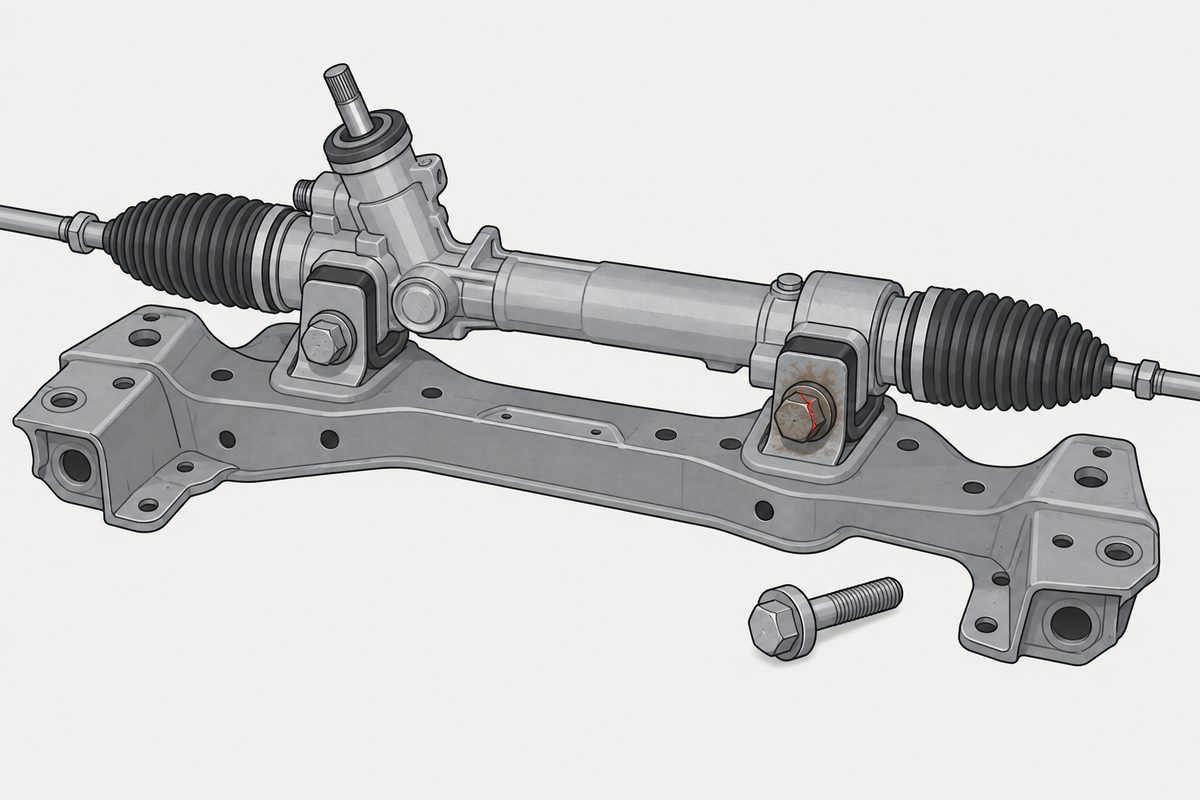
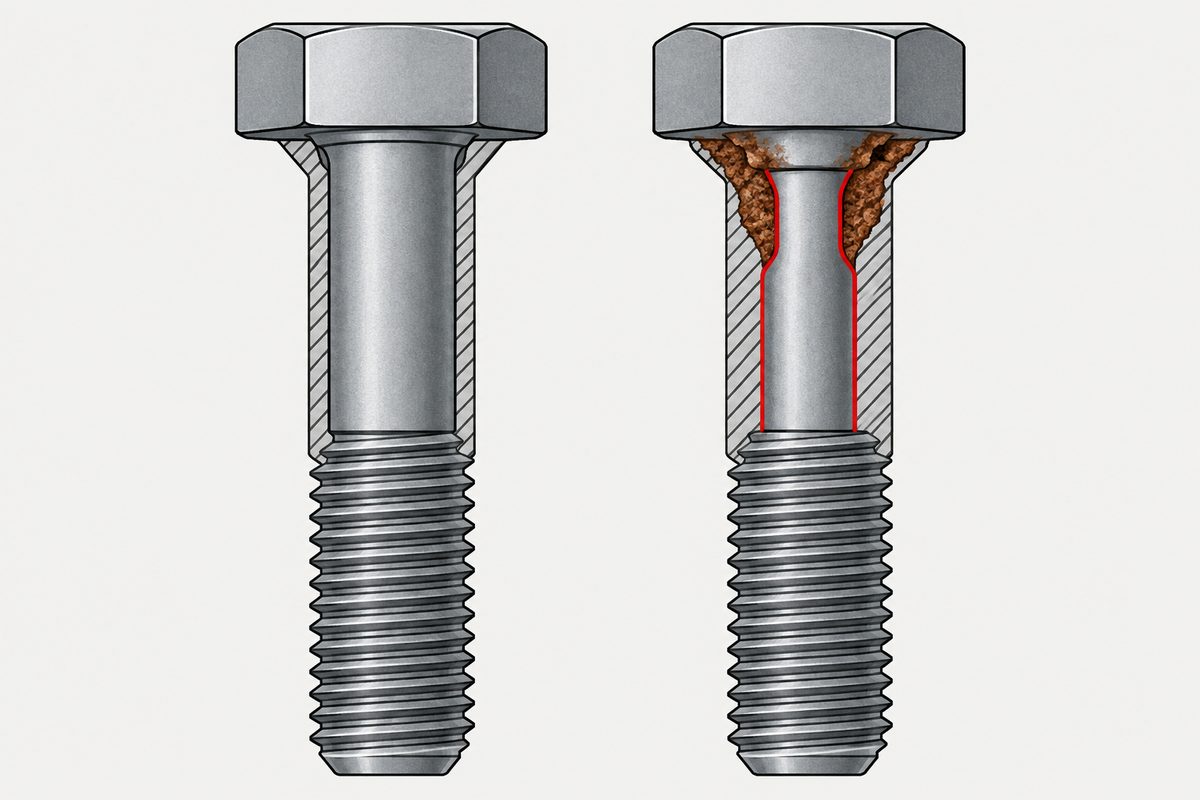
The mechanism comes from a report by the German tech publication heise on 22 September; it is not in the KBA records. According to heise, the bolt concerned is the right-hand one of the bolts that fix the rack-and-pinion steering gear to the front subframe. Over the life of the car, moisture can get into the area around it; with oxygen and road salt residue, the metal corrodes and the effective cross-section shrinks. Weakened far enough, the head can break off, mainly during slow manoeuvring and parking.
That last point is worth setting against another page on this site. When we read the US Consumer Product Safety Commission recalls from 2023 to 2026, the 24 notices that named a fastener as the cause split 11 loosening to 8 fracture, and that page suggested fracture is more often caught at the design stage by strength calculation (the analysis, in Chinese). This bolt had enough section when it was designed. It stopped having enough after years on the car, with part of the section rusted away. Strength calculations use the section of a new part, so they do not catch a failure that develops over time.
How much stress a little lost section adds
Axial stress in a bolt is the axial force divided by the load-bearing section. Hold the force constant, shrink the section, and stress rises in proportion. The table below is geometry only and not data for this bolt, whose size, property class and coating have not been published.
| Section remaining | Stress as a multiple of original | Increase |
|---|---|---|
| 90% | 1.11 | +11% |
| 80% | 1.25 | +25% |
| 70% | 1.43 | +43% |
Two things make corrosion worse than the averages suggest. Corrosion does not remove an even layer; it starts in crevices and under the head, where water stays, so the local section falls faster than the average. And a steering gear bolt sees repeated load, one cycle each time the wheel is turned; fatigue is more sensitive to lost section and surface damage than a single overload is. Both are general properties of fasteners, not statements by the KBA or VW about this bolt.
A new bolt, or a different bolt
The KBA remedy field says “a more corrosion-resistant bolt”. ADAC’s note of 29 September adds two sentences: in this campaign the existing bolt is replaced in every case, whatever its condition; but the improved bolt is being delivered to workshops gradually, so some cars will first receive a new bolt of the existing type, and may need a second visit once the improved part arrives.
For a fastener, those two replacements do different jobs. A new bolt of the same type restores the full section and a fresh surface treatment; it sets the corrosion clock back to zero. Its material and corrosion protection system are those of the bolt that failed, and in the same environment for the same time it will arrive at the same place. Only the improved bolt changes how fast the clock runs. The first is a way of buying time, and a sensible one for the owner, since replacing a bolt that has been rusting for years cuts the risk at once. It is not the same as a fix. Most reports said the bolt would be swapped for a more corrosion-resistant version and skipped this interim step.
What “more corrosion-resistant” consists of has not been published anywhere. The options include the coating system, the material, or sealing at the joint, each with different costs. Until the manufacturer says, this site will not guess.
How many cars is one per cent
Two German outlets quote the same proportion in different words. heise writes that Volkswagen estimates “about one per cent” of recalled cars have a bolt already rusted to a dangerous degree; t-online on 25 September puts the damage rate at “at most one per cent”. One says about, the other says at most, and neither quotes the manufacturer’s statement itself.
On the VW record’s 2,159,054 vehicles, one per cent is 21,591; on VW and Audi together, 2,855,601, it is 28,556. A small proportion of a large population is still more than twenty thousand cars with a steering bolt that is no longer strong enough. t-online also quotes a VW spokesperson as saying affected cars can still be driven, and that the repair takes up to an hour.
What this means for anyone specifying fasteners
Write “corrosion resistant” as something you can test. “More corrosion resistant” is a comparative; without the thing it is compared with, it cannot be accepted or rejected. The drawing needs the protection system and the verification method, and a salt spray figure needs its acceptance criteria next to it, or the number means little (Salt spray hours: what 500 hours buys, and what it does not).
Location matters more than the test panel. This bolt’s trouble came from moisture getting in around it and staying. A test panel hangs open in the cabinet; on the car, the crevices under the head, in the thread and between the joint faces are where it goes first. When specifying a coating, say whether the location traps water and sees road salt (How long will the coating last? Why no one will give you a number).
On a replacement, ask whether it is the same part number. A replacement under the same part number resets the clock. A new part number with a changed specification changes its speed. Either may be right, but you should know which one you have.
Before changing the coating on a high-strength bolt, check hydrogen embrittlement. The process that puts corrosion protection on can put hydrogen into hard steel (The rust-proofing that breaks the screw: hydrogen embrittlement). A coating change made for corrosion resistance has to be checked for this too.
What this page cannot conclude
No public document gives this bolt’s size, property class, material or original coating, and this page does not guess them. The KBA records do not name a vehicle platform, so neither does this page. One dealer article says Škoda is also included; the KBA search found no matching record, so it is not listed here. The one per cent figure is the manufacturer’s estimate as relayed by two outlets in inconsistent wording; this site has not read the original.
This page covers step 5, the finish. The whole order is substrate, thread, head, drive, finish, documentation, and why doing it out of order is rework rather than a tweak is in specifying a screw.
Common questions
What is wrong with the bolt in the VW recall?
The three KBA records (17016R VW, 17014R Audi, 17017R Seat) share one defect description: a bolt fracture can lead to loss of steering. The remedy is a more corrosion-resistant bolt. The mechanism comes from heise: the right-hand bolt fixing the rack-and-pinion steering gear to the front subframe can corrode when moisture, oxygen and road salt residue reach it, its effective section shrinks, and the head can break during slow manoeuvring or parking.
How many vehicles are recalled?
The KBA worldwide figures are VW 2,159,054, Audi 696,547 and Seat 66,224. The reported 2.86 million is VW plus Audi, 2,855,601; all three together are 2,921,825. In Germany, VW plus Audi is 954,387 and all three are 997,961.
Is one workshop visit enough?
Not necessarily. According to ADAC, the existing bolt is replaced in every case, but the improved bolt reaches workshops gradually, so some cars first get a new bolt of the existing type and may need a second visit. A new bolt of the same type restores the full section and a fresh surface treatment; its material and protection system are the same as the original.
Can affected cars still be driven?
t-online quotes a VW spokesperson saying they can, and that the repair takes up to an hour. All three KBA records list known incidents with damage or injury as none. Whether a particular car is included depends on its VIN, since the KBA notes that not every vehicle of a listed model is affected.
References
- Kraftfahrt-Bundesamt Rückrufdatenbank — searched by reference 17016R (VW), 17014R (Audi), 17017R (Seat), 2026-10-02
- heise online, 2026-09-22 (updated 09-27) — VW und Audi rufen fast eine Million Autos wegen Lenkungsproblem zurück
- ADAC, 2026-09-29 — Schraubenabriss am Lenkgetriebe: Rückruf bei Audi, VW und Seat
- t-online, 2026-09-25 — Rückruf bei VW und Audi: Darf man das Auto trotzdem weiter fahren?
- Euronews, 2026-09-25 — Over 2.8 million Audi and Volkswagen vehicles face recall worldwide
- 公開召回資料裡,螺絲比較常見的問題是鬆掉,不是斷掉 (in Chinese: CPSC recalls 2023–2026, 11 loosening against 8 fracture)
The three KBA records were looked up one by one by reference number on 2026-10-02; the figures and German sentences are copied from the database. The totals and the one per cent conversions are this site’s arithmetic. The corrosion mechanism, the right-hand bolt, the parking timing and the one per cent estimate come from heise and t-online; the interim same-type bolt comes from ADAC; none of these is in the KBA records. The section and stress table is geometry, not data for this bolt.
Enquiries
If you are specifying bolts for a location that traps water or sees road salt, put the location, the corrosion protection system and the verification method in the enquiry, and we will come back with coating and material options for that environment.
Request a quotation
Tell us the part and the quantity. We will come back on feasibility, lead time and price.
Or email us directly sales@tigerfasteners.com